Best Non Stick Cookware in 2026 — What’s Actually Worth Buying (And What Isn’t)
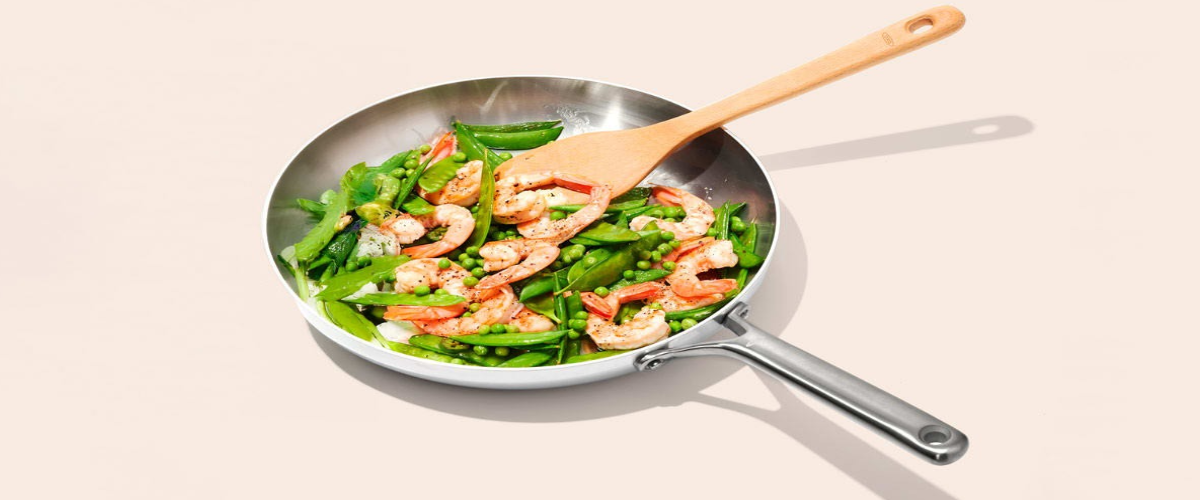
Let me tell you what happened when I finally looked up what was in my old nonstick pan.
The scratched Teflon fry pan I’d been using for three years contained PTFE — polytetrafluoroethylene — which is fine at normal temperatures and starts releasing fumes somewhere above 500°F. Overheating a nonstick pan happens. People get distracted. And the PFAS family of chemicals that includes PTFE has been linked in long-term studies to immune disruption, thyroid issues, and other things you’d rather not casually inhale while making scrambled eggs.
I threw the pan away that same week.
Finding the best non stick cookware that’s genuinely non-toxic turned out to be more confusing than it should be. Every brand claims to be PFAS-free. Some actually are. Some are using different PFAS compounds and just not disclosing it prominently. The PTFE lawsuit against HexClad — settled for $2.5 million in early 2025 over “non-toxic” marketing claims on pans that contained PFAS — tells you this confusion is real and consequential.
This guide covers what actually matters when choosing best non toxic cookware, which brands have the strongest credentials, and how Caraway specifically stacks up against the competition.
What "Non-Toxic" Actually Means in Cookware
Before any product recommendations, this needs explaining. Because the term gets used by brands whose pans would not pass rigorous independent testing.
PFAS are a family of thousands of synthetic compounds — Teflon (PTFE) is one of them. They’re called “forever chemicals” because they don’t break down in the environment or in the human body. PFOA, one specific PFAS compound, was banned from cookware manufacturing in the US in 2013. But PTFE itself wasn’t banned — and many brands still use it.
Truly non-toxic cookware means: no PTFE, no PFAS of any kind, no PFOA, no lead, no cadmium. And ideally, it means independently tested by a third-party lab — not just claimed on the packaging.
The chef Andrew Zimmern put it directly in a CNN Underscored piece: “Ask what the cooking surface physically is. If the company won’t tell you plainly, walk away.”
That’s the filter to apply before reading any brand’s marketing.
The Best Non Stick Cookware Brands in 2026
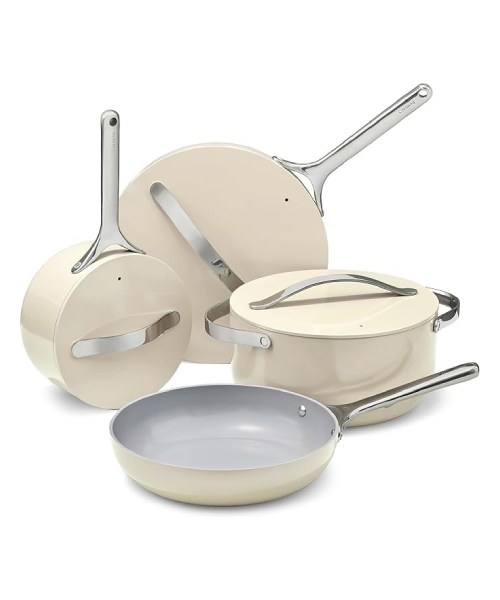
Price: ~$395 for the four-piece set
Coating: Mineral-based ceramic — PFAS-free, PTFE-free, PFOA-free
Independent testing: Light Labs — no detectable PFAS, lead, or cadmium
Caraway is the brand that brought non-toxic ceramic nonstick into mainstream kitchens. Founded in 2019, it built its reputation on one specific promise: the performance of traditional nonstick without the chemicals. Two layers of mineral ceramic coating over an aluminum body with a stainless steel induction-compatible base.
What makes Caraway genuinely stand out among the best ceramic cookware options isn’t just the safety certification — it’s the third-party verification. Light Labs independently tested the pans and found no detectable PFAS. That distinction between “we claim it’s non-toxic” and “a lab tested it and confirmed it” is the most important thing to look for in this category.
Performance is excellent for the cooking it’s designed for. Eggs release cleanly. Sauces don’t cling. Heat distributes evenly across the aluminum core without hot spots. One tester who’s owned her set since 2020 described it as a joy to cook with years later — still nonstick, still easy to clean.
The honest limitation: high heat degrades the ceramic coating faster. Caraway themselves ran an ad campaign acknowledging their pans won’t last forever. With proper care — medium heat, soft utensils, hand washing — most users get two to four strong years. Push them harder and that timeline shortens.
Best for: Health-conscious home cooks who cook eggs, fish, vegetables, and sauces at medium heat and want verified non-toxic credentials.
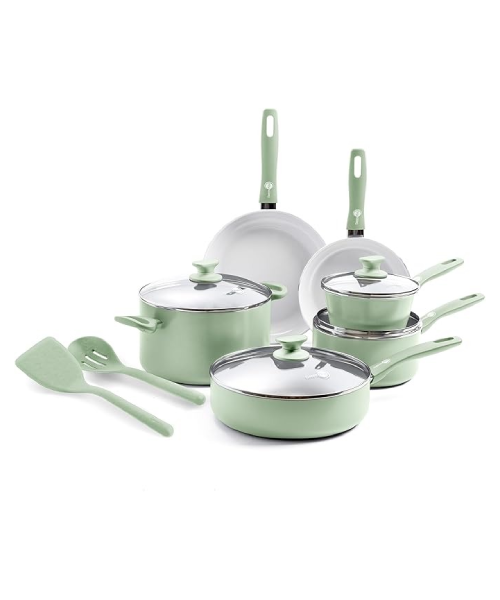
Price: ~$50–$200 depending on collection Coating: Thermolon ceramic (various grades by collection) Testing: PFOA-free across all collections; newer GP5 line claims PFAS-free
GreenPan has been in the best ceramic cookware conversation longer than anyone — they entered the US market in 2007 and are widely credited with pioneering ceramic nonstick cookware commercially.
The main differentiator between GreenPan and Caraway is durability engineering. GreenPan’s newer collections use hard-anodized aluminum bases with forged construction rather than welded — which makes the pans more resistant to warping under sustained heat. Their GP5 line’s Infinite8 coating claims metal utensil safety and dishwasher compatibility, which Caraway cannot match.
One important nuance: GreenPan’s older Thermolon coating still used some titanium compounds that showed up in third-party titanium leaching tests — an issue Caraway doesn’t have. In contrast, third-party tests showed no titanium leaching from Caraway pans. The newer GreenPan GP5 collection has improved on this, but it’s worth knowing the history before buying an older GreenPan model at a discount.
America’s Test Kitchen named the GreenPan Valencia Pro their best ceramic nonstick pan. At its price point — typically well under Caraway — it consistently outperforms expectations.
Best for: Buyers who want ceramic nonstick at a lower price point, dishwasher compatibility, or don’t want to worry as much about metal utensils.
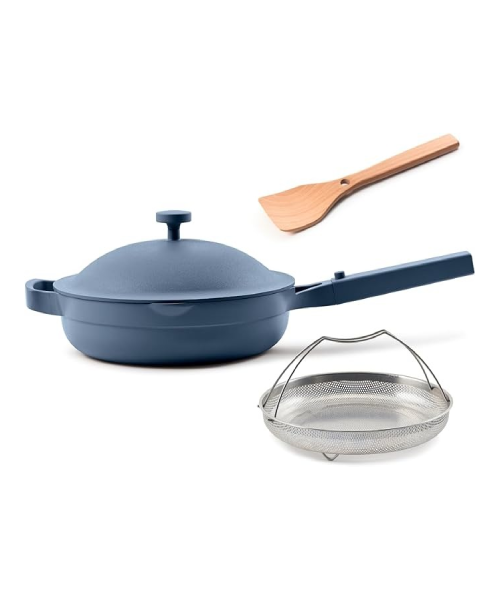
Price: ~$165 for the pan Coating: Ceramic nonstick, PFAS-free Best feature: Eight cooking functions in one pan
Our Place built a cult following on one central idea: what if you could replace eight different pans with one? The Always Pan 2.0 functions as a fry pan, sauté pan, steamer, skillet, saucier, strainer, server, and spatula rest all in one piece of cookware.
The ceramic coating is non-toxic and performs well. The design is genuinely clever — the nesting lid, the integrated spatula rest, the steamer basket that stores inside the pan. For small kitchens, couples, or anyone who wants a simplified cooking setup, the Always Pan is hard to argue with.
The limitation: it works well when you’re doing one thing at a time. Cooking a full dinner across multiple preparations simultaneously reveals that eight functions in one pan has trade-offs. And the ceramic coating carries the same high-heat sensitivity as Caraway — push it too hard and performance degrades.
Best for: People with small kitchens, minimalist cooks, anyone who wants to reduce their cookware footprint without sacrificing non-toxic credentials.
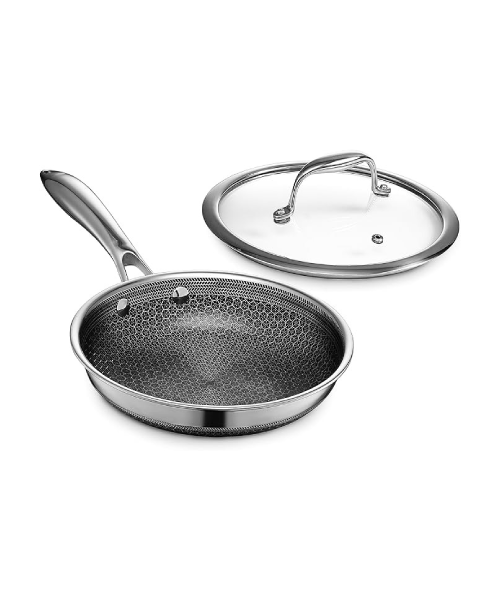
Price: ~$599+ for a seven-piece set Coating: TerraBond ceramic (as of 2025 — PTFE-free) Testing: Not yet independently published for the new TerraBond coating
HexClad’s history is worth knowing before buying. Their original pans contained PTFE — which they marketed as non-toxic and PFAS-free. A class action lawsuit was filed and settled for $2.5 million in early 2025 without admission of wrongdoing. They simultaneously switched to a new ceramic coating called TerraBond, which they say is PTFE and PFAS free.
The new TerraBond pans are a different product from the old PTFE ones. Independent testing of TerraBond hasn’t been published publicly yet — so unlike Caraway’s Light Labs verification, you’re currently trusting HexClad’s claims on this rather than an independent lab’s findings.
What HexClad does better than any ceramic brand: the raised hexagonal stainless steel pattern protects the ceramic underneath from physical damage. Metal utensils are fine. High heat is fine. Dishwasher is fine. For cooks who sear proteins, cook at high heat regularly, or simply can’t be careful with pans — HexClad’s hardware design solves real problems that ceramic coating alone doesn’t.
Best for: Cooks who need high-heat capability, metal utensil tolerance, and lifetime durability. Not the choice if independent third-party safety testing is your primary criterion.
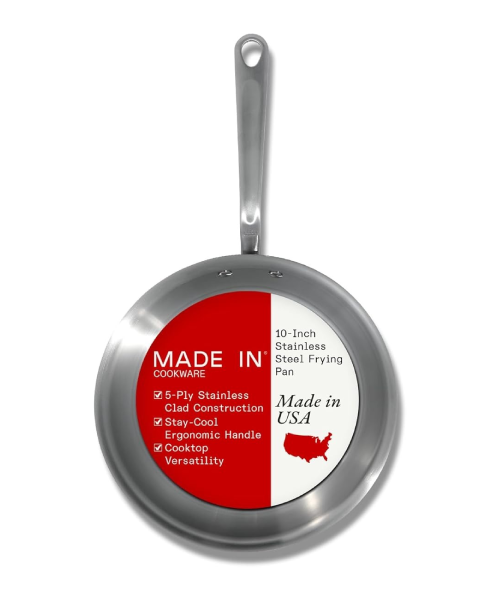
Price: ~$109–$199 per piece Coating: CeramiClad ceramic (their newer line) or stainless/carbon steel Made: USA and Europe
Made In sits slightly outside the ceramic-nonstick-first conversation because their strongest products are actually stainless steel and carbon steel — cooking surfaces that don’t require any coating and will last decades. Their CeramiClad ceramic line is well-made but their stainless sets are where serious home cooks and professional chefs consistently land.
If your goal is the best cookware brands for longevity and cooking performance across all techniques — searing, braising, sautéing, high heat, low heat, oven, broiler — Made In’s stainless or carbon steel is the honest answer. No coating to degrade. No chemicals to worry about. Just seasoning and maintenance.
The trade-off is learning curve. Stainless steel has a technique requirement that nonstick doesn’t — temperature management and knowing when to add food matters significantly. For new or casual home cooks, ceramic nonstick is genuinely more forgiving.
Best for: Intermediate to advanced home cooks who want professional-grade cookware that outlasts everything else in the kitchen.
How to Choose the Right Non Toxic Cookware for You
Before landing on a brand, answer three questions.
How do you mostly cook? If your daily reality is eggs, fish, vegetables, and gentle sauces at medium heat — ceramic nonstick works brilliantly. Caraway or GreenPan handles this well. If you regularly sear meat or cook at high heat — stainless, cast iron, or HexClad’s hybrid design will serve you better.
How careful are you with kitchen tools? Be honest here. If you own a wooden spoon and actually use it — ceramic nonstick is fine. If you’re going to grab a metal spatula out of habit without thinking — ceramic coating won’t survive that long. HexClad or stainless is the more realistic choice.
Do you need independent safety verification? If non-toxic credentials verified by a third party matter to you — and they should — Caraway’s Light Labs testing is the strongest current publicly available verification in the ceramic cookware category. GreenPan’s newer collections have improved but don’t have the same transparent third-party verification record. HexClad’s TerraBond is too new to have been publicly tested independently.
Quick Comparison Table
Brand | Coating Type | PFAS-Free | Independent Testing | Best Heat Range | Metal Utensils | Price (set) |
Caraway | Ceramic mineral | ✅ Yes | ✅ Light Labs | Low–medium | ❌ No | ~$395 |
GreenPan (GP5) | Thermolon Infinite8 | ✅ Yes | Partial | Low–medium-high | ✅ Yes | ~$150–$300 |
Our Place | Ceramic | ✅ Yes | Not published | Low–medium | ❌ No | ~$165 |
HexClad (new) | TerraBond ceramic | ✅ Claimed | ❌ Not yet | Low–very high | ✅ Yes | ~$599+ |
Made In | Stainless/carbon/ceramic | No coating | N/A | All | ✅ Yes | ~$109+ per piece |
What Makes Caraway Specifically Worth Considering
In the best non stick cookware conversation, a few things set Caraway apart from the other ceramic brands.
The Light Labs third-party testing is the clearest differentiator. No PFAS, no lead, no cadmium — confirmed independently, not just stated in marketing copy. That verification is harder to earn than most buyers realize and it’s the most meaningful quality signal in this category.
The storage system that comes with the set — magnetic pan racks and canvas lid holder — is genuinely thoughtful. It’s not a marketing add-on. Multiple independent users describe it changing how their kitchen functions. Small detail, real impact.
The design, obviously. Eight-plus color options. Beautiful on a stovetop. Available in Target and Crate & Barrel exclusives. For buyers who care about what their kitchen looks like, Caraway delivers aesthetic that most competitors don’t attempt.
The honest caveat remains the coating lifespan. Every ceramic nonstick pan has a finite useful life. Caraway ran ads acknowledging theirs won’t last forever — which is either refreshing honesty or a low bar depending on how you read it. Treat the pans carefully and two to four strong years is realistic. That’s the deal.
Final Recommendations
Buy Caraway if: Non-toxic verification matters, you cook at medium heat, and you want beautiful cookware that includes storage organization.
Buy GreenPan if: You want ceramic nonstick at a lower price with more durability on metal utensils and dishwasher tolerance.
Buy Our Place if: You want to simplify your kitchen to fewer pieces without giving up non-toxic performance.
Buy HexClad if: You cook at high heat regularly, want metal utensil compatibility, and can accept that independent TerraBond testing isn’t yet publicly available.
Buy Made In if: You want cookware that genuinely lasts decades, are willing to learn proper technique, and don’t need nonstick coating.
The best ceramic cookware for most home cooks is Caraway — the third-party verification, the design, and the storage system together make it the most compelling complete package. But it’s only the right choice if you understand what ceramic nonstick is and is not built for. Go in knowing that, and it delivers exactly what it promises.