Most Comfortable Ariat Work Boots: A Job-by-Job Guide for 2026
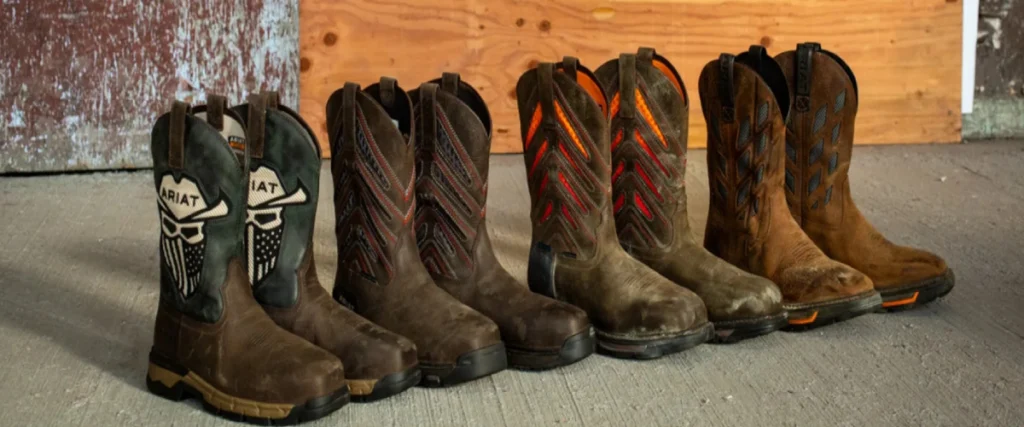
Here’s a problem nobody talks about enough when it comes to work boots: the most comfortable boot for standing on concrete all day is not the same boot as the most comfortable one for climbing ladders. And the boot that feels perfect in an oil field is going to feel like wearing ankle weights in a warehouse.
Ariat makes some of the most comfortable work boots available in 2026. But they make a lot of them — and choosing wrong means spending $200 on something that doesn’t solve your actual problem.
This isn’t a list of every Ariat boot. It’s a job-by-job breakdown of the most comfortable Ariat work boots matched to what you’re actually doing all day. Find your job. Buy that boot.
First — Why Ariat Boots Feel Different
Before getting into specific picks, it’s worth understanding why Ariat keeps coming up in conversations about comfort. Because it’s not just marketing.
The ATS system — Advanced Torque Stability — was designed for equestrian riders who stand in stirrups for hours. Four layers work together: a cushioned footbed, nylon stability plate, fiberglass shank, and outsole. The result distributes foot pressure evenly instead of letting it concentrate at stress points. That’s the reason workers who switch to Ariat from cheaper boots notice the difference by early afternoon — it’s the hours six, seven, and eight where the technology earns its cost.
The Duratread outsole is 45% harder than standard rubber, oil and slip resistant, and hot-contact rated to 572°F. The 90° heel provides secure footing on ladder rungs. And the width options — regular, wide, extra-wide — mean a significant number of people who’ve been suffering in the wrong-width boot their whole career can finally find something that actually fits.
None of this matters if you buy the wrong model. Here’s how to get the right one.
If You Stand on Concrete All Day
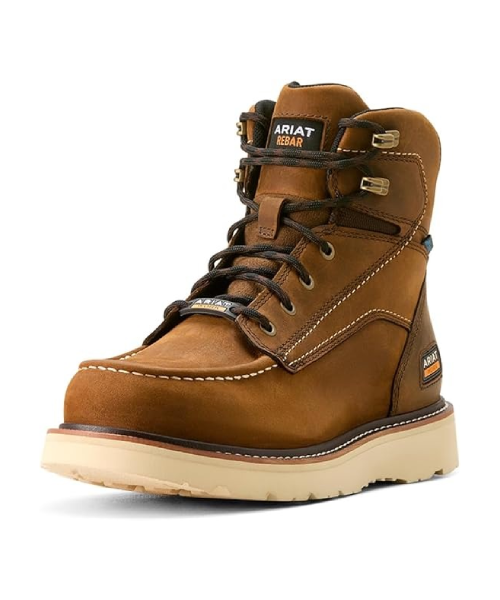
Concrete is specifically brutal on feet because it doesn’t give. Every step transfers impact straight upward — through the sole, through the heel, into the ankle, knee, and back. After eight hours your legs know about it even if your feet don’t.
The Rebar Wedge solves this with a flat-bottom wedge sole and 4LR technology. The flat bottom maximises contact with hard flooring — distributing your weight across a larger surface area rather than concentrating it under the heel and ball of the foot the way a heeled boot does. The 4LR midsole absorbs the shock that concrete sends back up.
Workers in manufacturing, warehousing, factory settings, and distribution centres consistently cite the Rebar Wedge as the boot that changed how their legs felt at the end of a shift. One verified buyer who works in manufacturing specifically mentioned that her feet still felt good after a full day on concrete — that’s what the wedge design is built for.
Waterproof version available | Composite toe option
If You Climb Ladders and Move Around All Day
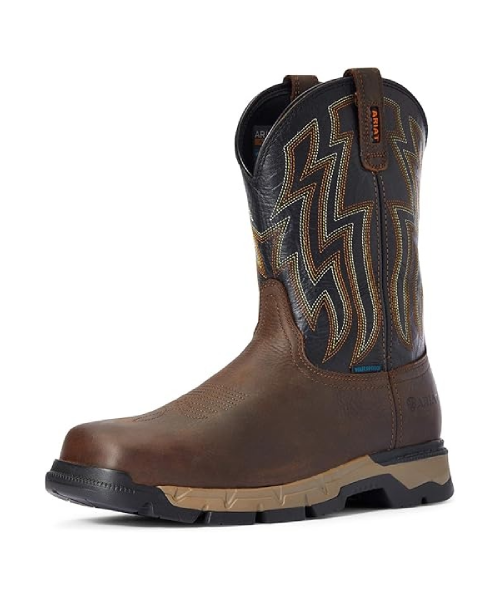
Static comfort and active comfort are different things. A boot that feels great standing still can become exhausting when you’re bending, crouching, and climbing because a rigid sole fights the natural flex of your foot.
The Rebar Flex has a flexible Duratread outsole that bends with the foot during movement. An HVAC technician’s verified review described switching from another brand and finding the Rebar Flex comfortable all day — even in a job that involves constant ladder climbing, kneeling in tight spaces, and uneven surfaces. The 4LR cushioning absorbs impact without adding weight. The composite toe keeps it lighter than steel.
This is the most comfortable Ariat work boot for workers whose job description involves moving continuously rather than standing still.
Waterproof version available | Composite toe standard
If You Work in Oil and Gas or Heavy Outdoor Conditions
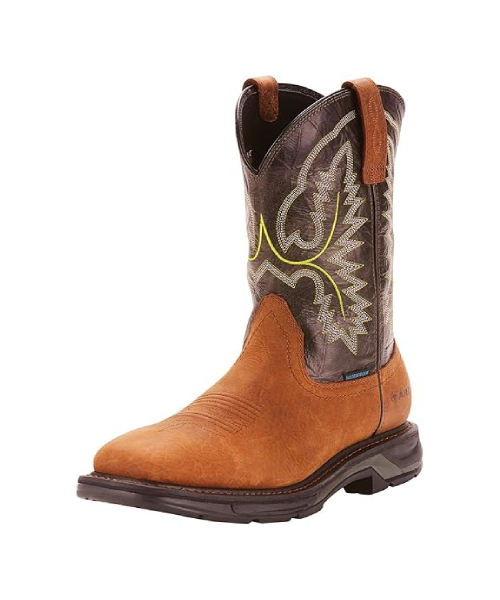
The WorkHog XT is the boot Ariat built specifically for oil field environments — and it’s the most technically advanced comfort platform in their entire lineup.
ATS Max delivers extra-wide midfoot support with a dual-density EVA midsole — soft cushioning on top for each step, firm support below so the foot doesn’t fatigue through. The Energy Max anti-fatigue insole adds a third layer of shock absorption. Multiple independent reviewers named this the most comfortable work boot they’d tested at any price.
DRYShield waterproofing — full-grain waterproof leather plus an internal breathable barrier — keeps feet dry in genuinely wet conditions. One verified buyer described walking into eight inches of standing water on an oil site and finishing the shift with dry feet. The Duratread outsole handles oil, heat, and slip. Carbon toe version carries ASTM F2413 and F2892 certifications.
Wide and extra-wide widths available. The U-Turn Entry System makes it accessible for high-arch wearers.
This is a serious boot with a serious price. It earns it.
DRYShield waterproof | Carbon or soft toe
If You Need Comfort on a Budget
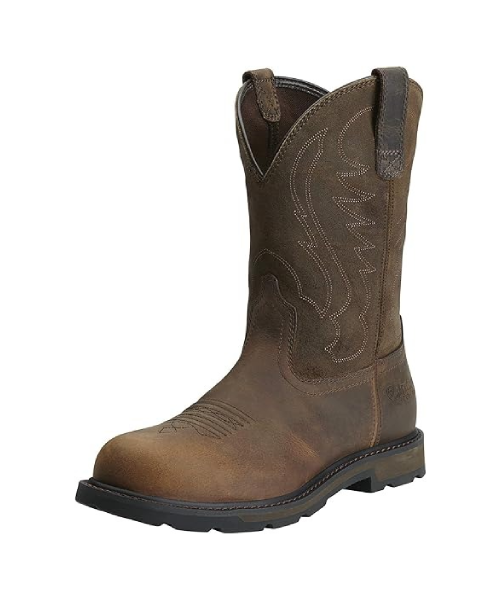
The Groundbreaker is Ariat’s most purchased work boot, and the reason is simple — it delivers more comfort than it has any right to at under $165.
The 4LR midsole provides genuine all-day cushioning. No break-in period. Workers who’ve switched from cheaper boots describe wearing them through twelve-hour first shifts without foot pain. One Zappos reviewer had been wearing Ariat for ten years and said he’d never had sore feet at the end of a shift since switching — describing it as the best thing he’d discovered in his working life. Another had owned the boots for so long he’d only bought three pairs over a decade, because each lasted years.
Not waterproof in the standard version. Cemented sole can’t be resoled. Runs half a size large — order accordingly. None of that changes the fact that for light-to-moderate daily work, the Groundbreaker is one of the best buys in work boots regardless of brand.
Not waterproof standard | Steel toe option available
If You Want Comfort You Can Also Wear After Work
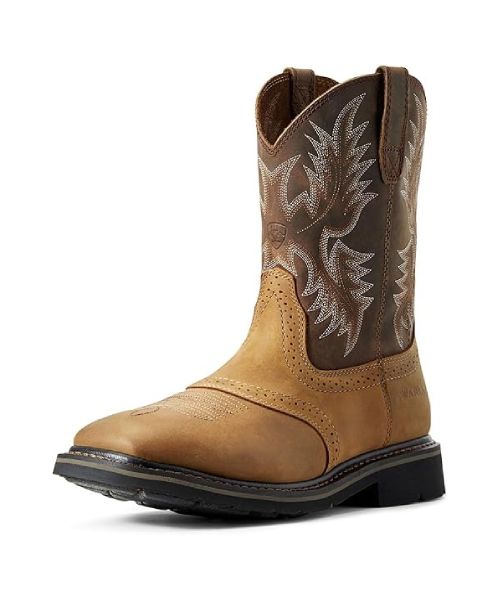
The Sierra is the most comfortable Ariat work boot for workers who don’t want their footwear announcing itself as workwear the moment they walk into a restaurant or a hardware store on the weekend.
Finer full-grain leather than the WorkHog. Traditional western profile. Detailed stitching. It looks like a quality boot rather than a safety boot — and underneath it carries ATS support and Duratread outsole. Holds a 4.4-star rating on Zappos across hundreds of verified purchases. Steel toe version available. Shock Shield midsole upgrade for added impact absorption on hard floors.
The tradeoff: it’s not waterproof in the standard version, and the aesthetics mean it’s better suited to moderate daily work than heavy outdoor environments. But for workers who want one boot that goes from the job site to wherever the evening takes them without a wardrobe change, the Sierra earns its place.
Not waterproof standard | Steel toe available
The One Question to Ask Before Buying
Before you pick any of these, answer one question: does your foot spend more time moving or standing still?
Standing still all day — wedge sole boots (Rebar Wedge). Moving and climbing — flexible sole boots (Rebar Flex). Heavy outdoor and uneven terrain — maximum support (WorkHog XT). Budget daily wear — Groundbreaker. Style plus function — Sierra.
That question cuts through most of the confusion. The best Ariat work boots for comfort are the ones matched to your specific physical demands — not just the ones with the highest cushioning rating on paper.
Quick Comparison
Boot | Best For | Price | Waterproof | Sole Type |
Rebar Wedge | Standing on concrete | ~$165–$200 | ✅ Available | Flat wedge |
Rebar Flex | Active movement, ladders | ~$175–$215 | ✅ Available | Flexible |
WorkHog XT | Oil field, heavy outdoor | ~$240–$270 | ✅ DRYShield | Traditional |
Groundbreaker | Budget daily wear | ~$130–$165 | ❌ Standard | Cemented |
Sierra | Work + casual versatility | ~$170–$180 | ❌ Standard | Traditional |
Three Things That Affect Comfort More Than the Boot
Insoles. Every Ariat boot comes with a removable insole. Replacing it with an aftermarket option — Superfeet, Powerstep, or Ariat’s own work insoles — can meaningfully extend comfort on twelve-hour shifts, especially for workers with plantar fasciitis or high arches.
Width. Ariat offers regular, wide, and extra-wide across most models. A boot that’s the right length but wrong width creates pressure points that no cushioning system can fully offset. If you’ve always had foot pain in work boots, getting the correct width may fix more than a better boot would.
Replacing boots on schedule. Midsole foam compresses over time. A boot that was comfortable in January may have lost 30% of its cushioning by August if you’re wearing it daily. Ariat’s Goodyear-welted models can be resoled when the outsole wears — but the insole and midsole still need attention on a separate schedule.
What Ariat Workers Actually Say
The most reliable signal in work boot reviews is specificity — when a buyer describes exactly how a boot performed in their specific job, that’s worth more than a generic five-star rating.
Here’s what comes up consistently across verified Ariat reviews:
- “I’ve worn Ariat for ten years. Never sore feet at the end of the day. Wish I’d found them thirty years ago.”
- “Standing on concrete in manufacturing all day — feet still felt good at the end of the shift. That’s new for me.”
- “I work HVAC. These exceeded my expectations. Comfortable all day, even in tight spaces.”
- “This is my tenth pair of the WorkHog Composite Toe. I get a year’s solid work out of each pair and keep coming back.”
- “Runs large on the Groundbreaker — needed half a size down. Once sized right, these are exceptional.”
Who Should Skip Ariat
Not for everyone. If you work indoors in light conditions and comfort isn’t your main concern, you don’t need to spend $200 on ATS technology. A basic boot at $80 does that job.
If you have specific medical foot conditions — severe plantar fasciitis, custom orthotics requirements — talk to a podiatrist before choosing any boot, including these. The ATS system is excellent general support but it’s not a clinical device.
And if you’re buying primarily for aesthetics with minimal work function needed, there are western boot brands that specialise in style without the work-boot engineering premium.
Final Verdict
The most comfortable Ariat work boots aren’t necessarily the most expensive ones. They’re the ones designed for your specific job.
Standing on concrete: Rebar Wedge. Climbing and moving: Rebar Flex. Demanding outdoor work: WorkHog XT. Budget daily comfort: Groundbreaker. Work-to-weekend versatility: Sierra.
Get the job-matched boot, get the right width, replace insoles when they compress, and the foot pain that most workers accept as part of the job stops being something they accept.
That’s the whole promise Ariat makes. Based on the pattern of buyers who’ve switched and never gone back, they deliver on it.