AquaTru Countertop Water Filter Reviews 2026 — I’ve Been Drinking This Water Every Day. Here’s What I Think.
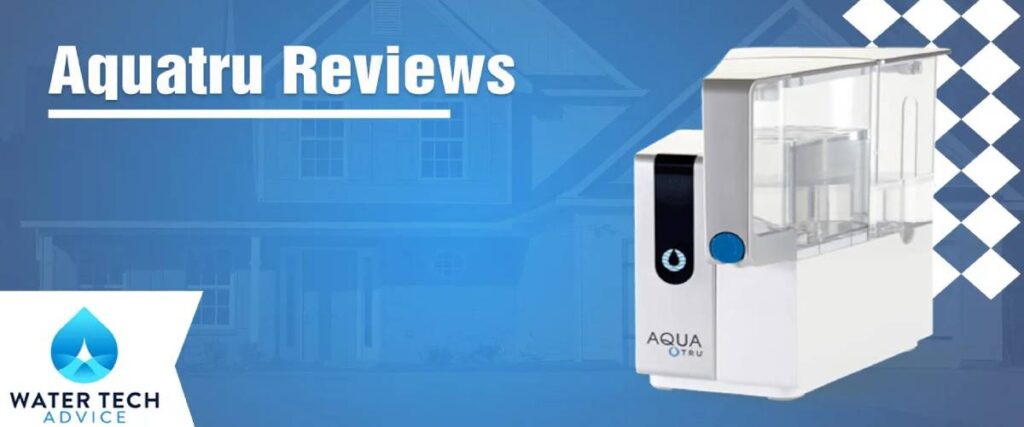
I typed my zip code into the Environmental Working Group’s tap water database on a Tuesday evening and didn’t sleep particularly well that night.
My water had detectable PFAS compounds, chloramines above the EWG health guidelines, and nitrates that technically cleared EPA legal limits but not the kind of limits that make you feel relaxed about drinking it every day for decades. I’d been using a Brita for years. That evening I learned Brita doesn’t touch PFAS. Doesn’t touch fluoride. Doesn’t touch most of what I’d just read about.
Two weeks later I had an AquaTru Classic sitting on my counter. That was eight months ago and I’ve filled it almost every day since. Here’s what the aquatru countertop water filter reviews conversation actually needs to cover — the good, the costs, and the things that surprised me.
Quick Highlights
- ✅ Removes 84 certified contaminants — PFAS, lead, fluoride, microplastics, nitrates, arsenic
- ✅ Five NSF/ANSI certifications — the most of any countertop RO system currently available
- ✅ No plumbing required — fills manually, plugs into a standard outlet
- ✅ Named Best Countertop Water Purifier by Good Housekeeping 2026 Kitchen Awards
- ✅ 30-day returns on most items, phone support available 24/7 at 800-220-6570
- ✅ Under-sink version available for homeowners who want permanent installation
- ❌ Tank size is small — 0.75 gallons of clean water, needs frequent refilling for larger households
- ❌ Annual filter costs of $100–$120 are easy to underestimate at purchase
- ❌ RO strips minerals — water can taste flat if that bothers you
- ❌ Pump failures reported around 12–24 months of use by a documented subset of buyers
- ❌ Customer service handling of warranty claims has been inconsistent based on BBB and Trustpilot accounts
Best for: Renters who can’t install under-sink systems, health-conscious households, anyone who’s looked up their local tap water quality and wants to actually do something about it, people currently spending money on bottled water.
Why Trust This Review
Eight months of daily use with the AquaTru Classic. Cross-referenced with independent lab testing data from Tap Score and RO Filter Lab, NSF certification documentation, and verified customer accounts from Trustpilot, BBB, and PissedConsumer. No commercial relationship with AquaTru.
Table of Contents
- About AquaTru
- How the Technology Actually Works
- AquaTru Countertop Reverse Osmosis Water Reviews — Daily Reality
- The Filter Cost Truth
- Best Products Worth Buying
- What Customers Actually Say
- Is AquaTru Worth It?
- AquaTru vs Brita
- Where to Buy
- FAQs
- Final Verdict
About AquaTru
AquaTru is made by Ideal Living, a California-based company that also makes AirDoctor air purifiers. The brand was started because the founder experienced a real-life poisoning from toxic cookware — that’s the origin story — and it drove him toward building products that eliminate chemical exposure in daily life. The countertop RO filter was the flagship result of that mission.
The brand has genuine credibility markers. Erin Brockovich publicly endorses AquaTru — and given that her career has been built on water contamination cases rather than general wellness influencing, that carries different weight than a typical celebrity attachment.
AquaTru has partnered with the Environmental Working Group to build a tap water quality checker on their website pulling from 48,000+ municipal supplies nationally. Look up your zip code before or after reading this. The results are frequently surprising and always instructive.
The product lineup now covers the Classic countertop, the Carafe (glass pitcher version), a Smart version with WiFi monitoring, an alkaline version that remineralizes post-filtration, and an under-sink model for permanent installation. All share the same 4-stage filtration philosophy; the differences are in form factor and features.
How the Technology Actually Works
Reverse osmosis is a physical filtration process, not a chemical one. Water is forced through a semi-permeable membrane with holes small enough to block dissolved contaminants at the molecular level. It’s how desalination plants make seawater drinkable. In a home setting, it’s the most thorough water purification technology available outside of industrial equipment.
AquaTru’s 4-stage process: Stage 1 catches sediment, rust, and visible particles. Stage 2 is a carbon pre-filter that removes chlorine and chloramines, which protects the RO membrane and improves taste. Stage 3 is the RO membrane itself — where lead, fluoride, arsenic, chromium-6, microplastics, nitrates, and heavy metals get blocked. Stage 4 is a coconut shell carbon block that catches what made it through, primarily PFAS compounds and VOCs.
The result: 84 contaminants removed. Not claimed removed — certified removed by IAPMO to NSF/ANSI standards 42, 53, 58, 401, and P473. Five independent certifications. P473 specifically covers PFAS reduction, which is the standard that’s hardest to earn and the one most people care about. In Tap Score independent lab testing, the Classic reduced PFAS, microplastics, and trihalomethanes to non-detectable levels.
No other countertop RO system currently holds all five of those certifications. That’s the single most important thing to know about this product relative to alternatives.
AquaTru Countertop Reverse Osmosis Water Reviews — Daily Reality
Setup takes ten minutes. Fill the tap water tank, run an initial flush cycle four or five times to condition the system, and you’re making clean water. No tools. No drilling. No plumber. For renters especially, this is the whole point — RO-level purification without any conversation with a landlord.
Day-to-day: fill the tap water tank, the system runs its filtration cycle, clean water accumulates in the front tank. When you want water, pour from the front tank. Simple.
The thing nobody explains well in advance: the wastewater situation. RO systems produce concentrate — water with all the removed contaminants — as a byproduct. In AquaTru’s design this collects in the tap water tank during filtration. You need to dump it before refilling. New users regularly forget this and occasionally drink from the wrong side. Not dangerous — it’s concentrated tap water — but confusing and alarming until you understand what’s happening. Dump the tap water tank before every refill. Write it on a note for the first two weeks.
The tank size is the practical limitation for larger households. The Classic’s clean water tank holds 0.75 gallons. For one or two people this is fine — refill a couple of times a day, move on. For a family of four drinking water, cooking with it, and filling a pet bowl, you’re refilling the tap tank more often than you might expect. One Trustpilot reviewer put it plainly: the unit is really ideal for a single user or couple — larger households should look at the under-sink model.
The taste improvement is real and most people notice it immediately. The chemical flatness of treated municipal water disappears. Coffee tastes notably different — multiple buyers specifically mention their coffee improving, which is a reliable proxy for overall water quality since coffee is extremely sensitive to dissolved compounds.
One thing that takes some adjustment: RO water has very low total dissolved solids because the membrane removes everything including minerals. Some people love this clean, neutral taste. Others find it flat or hollow — particularly if they’re used to good mineral water. AquaTru’s alkaline version adds minerals back in post-filtration and is worth considering if you’ve had RO water before and found the taste lacking.
The Filter Cost Truth
The machine costs $449 for the Classic, $399 for the Carafe. That feels like the total cost. It isn’t.
Filters replace on schedule: Stage 1 every 6–12 months, Stages 2 and 4 every 12 months or 600 gallons, Stage 3 (the RO membrane) every 24 months or 1,200 gallons. Annual running cost: approximately $100–$120. Over five years: $949–$1,049 all-in for the Classic.
Compare that to bottled water. A household spending $50 a month on bottled water spends $600 a year. AquaTru becomes cheaper than bottled water within two years and keeps getting more economical after that. The math is clear once you actually do it. The frustration comes when buyers don’t do it before purchase and then feel ambushed by filter replacement costs.
One more thing: AquaTru’s one-year warranty is on the shorter end for an appliance at this price. Multiple BBB complaints describe pump failures happening around the 12–24 month mark — sometimes just inside warranty, sometimes just outside. One BBB filing described a Carafe unit stopping working after its first week of March 2026, requesting replacement, then having the ticket closed as “non-responsive” by the support team 28 minutes after it was opened. That’s a specific, documented case. Not every buyer experiences this, but it happens with enough documented frequency to be part of any honest aquatru countertop water reviews conversation.
Best AquaTru Products Worth Buying
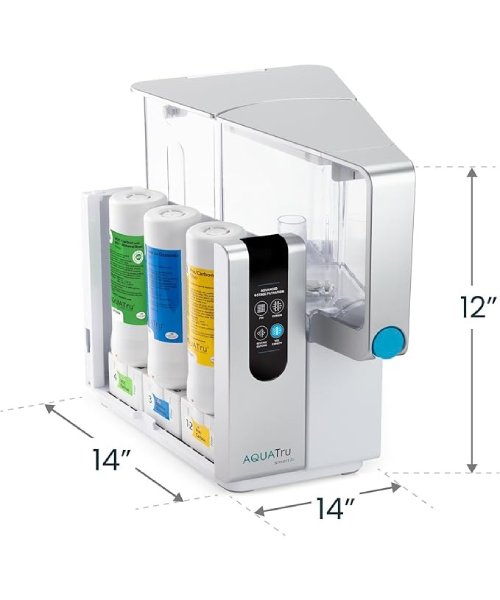
Best for: Most households wanting certified RO purification without plumbing installation.
The flagship. Five NSF certifications, 84 contaminants removed, 4-stage filtration, oven-safe tanks, no installation. The benchmark product in the countertop RO category with no real equivalent on certifications.
One honest drawback: The 0.75-gallon clean water tank is limiting for high-consumption households. Refilling the tap water tank multiple times daily gets old.
Verdict: The most certified countertop RO system available. If verified non-toxic water matters to you and you can’t install under-sink, this is the right tool.
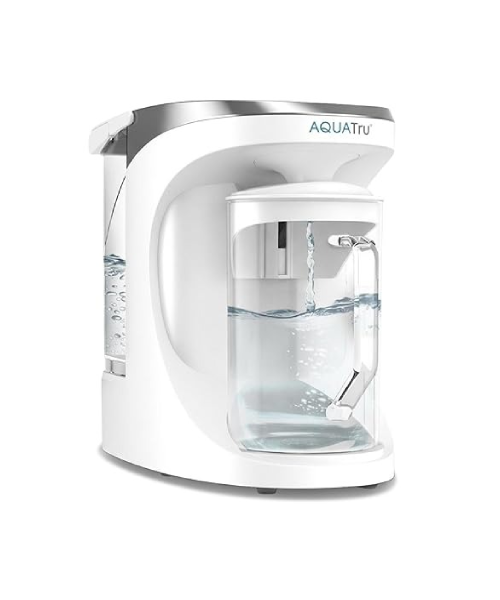
Best for: Smaller households, buyers who prefer glass over plastic, anyone for whom the Classic’s footprint is a real problem.
Identical 4-stage filtration and all five NSF certifications as the Classic. Uses a glass carafe rather than plastic tanks — a meaningful difference for buyers concerned about plastic contact with clean water. Named Best Water Purifier 2025 by Esquire and winner of Good Housekeeping’s 2026 Kitchen Award.
One honest drawback: Smaller capacity than the Classic — processes one full feed tank in 12–15 minutes for about 8 cups. High-consumption households will feel this quickly.
Verdict: For one or two people who care about the glass-versus-plastic distinction, the Carafe is the right version. Same water quality, smaller footprint, better materials for clean water storage.
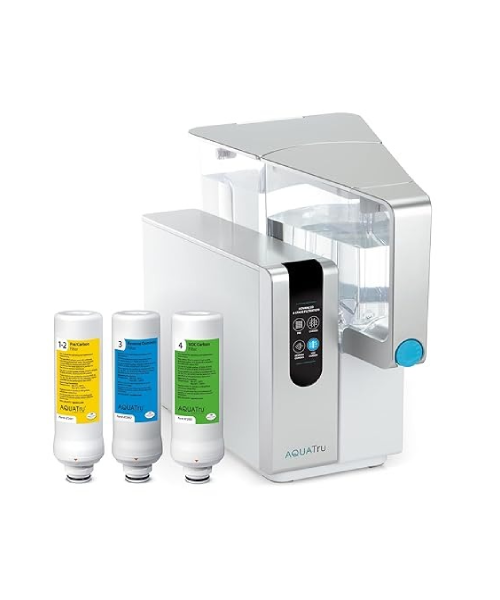
Best for: Anyone who has tried standard RO water before and found the taste flat, or who wants the remineralization benefits alongside purification.
Same 4-stage system, with the Stage 4 VOC filter replaced by an alkaline remineralization filter that adds calcium, magnesium, and potassium back into the purified water while raising pH slightly. Addresses the most common taste complaint about RO water without compromising the upstream contaminant removal.
One honest drawback: Alkaline filter replacement costs slightly more than the standard VOC filter, adding a small increment to annual running cost.
Verdict: If you’ve had RO water before and found it hollow-tasting, buy this version. The remineralization makes a genuine difference that’s immediately noticeable.
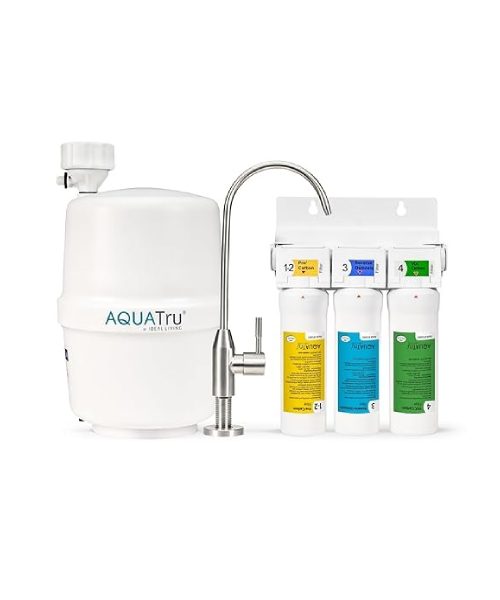
Best for: Homeowners ready to commit to permanent RO filtration who want clean water directly from the tap with no countertop footprint and no manual refilling.
Connects to your cold water supply line, produces RO water through a dedicated faucet. Same 4-stage filtration technology and NSF certifications as the countertop models, with higher daily output capacity. Solves the tank refilling problem permanently.
One honest drawback: Requires basic plumbing work — connecting to supply lines and drilling for the dedicated faucet. Not for renters, not an option for confident beginners.
Verdict: The logical upgrade for Classic owners who move into a home they own. Same trusted filtration, no manual interaction required.
What Customers Actually Say
The aquatru countertop water filter reviews picture across verified platforms is more nuanced than the brand’s own testimonials suggest.
The water quality improvement is the thing most people agree on immediately. The taste shift is real and described consistently — no chemical smell, no flat treated-water character, coffee that tastes better, a general sense of drinking something cleaner. One Trustpilot reviewer who’d been skeptical described being impressed with the third-party test results and the taste within the first three weeks.
The reliability concerns are documented and specific. BBB complaints describe pump failures, leaking units, and support experiences where warranty tickets were closed prematurely. One buyer filed a BBB complaint describing a safety-critical leak in April 2026 that resulted in over a month of missed deadlines from AquaTru’s support team before resolution. A separate buyer described their Carafe stopping entirely in its first week of March 2026, a replacement being promised, then cancelled 28 minutes later with the ticket marked closed.
These aren’t the majority experience. Most buyers describe the unit working reliably for years. But the failure pattern is consistent enough — and the warranty is short enough — that it’s worth knowing.
Real accounts paraphrased from verified sources:
- “Simple to set up, the water tastes noticeably better. I drink far more water now than I did before because it tastes so clean. Really pleased with it.”
- “The carafe took some getting used to with the wastewater situation but once I understood the process it’s perfectly easy. The water quality is excellent.”
- “My machine’s motor stopped after about four years of use. Customer service told me it was due to high mineral content — something I wasn’t informed about at purchase.”
- “Unit stopped working after first week of March. Asked for replacement. Was promised one. 28 minutes later told I was non-responsive and ticket closed. Replacement cancelled. Terrible support.”
- “I’ve had mine for two years with zero problems. The water is genuinely different. My coffee has never been better.”
Is AquaTru Worth It?
For renters who can’t install under-sink RO: yes, clearly. Nothing else delivers this level of certified contaminant removal without plumbing.
For households currently spending on bottled water: yes. The math favours AquaTru within two years and keeps improving after that — while also eliminating single-use plastic waste.
For households where PFAS, lead, fluoride, or nitrates are a documented concern in local tap water: yes. The five-certification profile is the strongest independent verification in the countertop category.
Where it gets more complicated: the one-year warranty on a $449 appliance, the documented pump failure pattern around 12–24 months, and customer service inconsistency on warranty claims. Factor those in. The filtration works. The long-term reliability is less certain than it should be for the price.
AquaTru vs Brita — Not the Same Thing
People compare these because both sit on the counter and both filter water. They don’t do the same thing.
AquaTru Classic | Brita Pitcher | |
Technology | 4-stage Reverse Osmosis | Activated carbon |
Removes PFAS | ✅ Yes — NSF P473 | ❌ No |
Removes lead | ✅ Yes (99%+) | Partial — some models |
Removes fluoride | ✅ Yes | ❌ No |
Removes microplastics | ✅ Yes | ❌ No |
NSF certifications | 5 | 1–2 |
Needs electricity | Yes | No |
Annual filter cost | ~$100–$120 | ~$40–$80 |
Upfront cost | $449 | ~$35 |
Best for | Certified contaminant removal | Taste and basic chlorine reduction |
Brita isn’t a bad product for what it does. But the moment your concern is PFAS, lead, fluoride, or anything beyond chlorine taste — a Brita doesn’t have a meaningful answer. AquaTru does, with independent lab verification.
Where to Buy
AquaTru sells directly through aquatruwater.com with phone support at 800-220-6570 available 24/7. They’re also available on Amazon and at major retailers. Promotional codes and bundle deals typically apply only on the direct site.
Black Friday and seasonal events bring the deepest discounts — 30–40% off the machines themselves, which is meaningful on a $399–$449 purchase. Signing up for the AquaTru email list before buying is the simplest way to catch promotional pricing.
HSA and FSA funds can be used to purchase AquaTru products — both the Classic and Carafe are eligible. Using pre-tax health savings effectively reduces the real cost by 20–30% depending on your tax bracket.
FAQs
Does AquaTru actually remove PFAS?
Yes. PFAS reduction is certified under NSF/ANSI P473 — third-party laboratory verified, not just claimed on packaging. In Tap Score independent testing, PFAS levels were reduced to non-detectable.
Does AquaTru remove fluoride?
Yes, at 93.5%+ per NSF/ANSI P473 certification. Most carbon pitcher filters including Brita do not remove fluoride at all.
How often do the filters need replacing?
Stage 1 every 6–12 months. Stages 2 and 4 every 12 months or 600 gallons. Stage 3 (RO membrane) every 24 months or 1,200 gallons. Annual cost runs approximately $100–$120.
Can renters use AquaTru?
Yes — this is one of the primary use cases. No plumbing modification required, nothing permanent, nothing that requires landlord permission.
What is the warranty?
One year from purchase. Phone support available 24/7 at 800-220-6570. Some warranty claims have been resolved smoothly; others have generated documented complaints about delays and closed tickets. Keep records of any support interactions.
Is the water safe for making coffee and tea?
Multiple users specifically mention improved coffee quality after switching to AquaTru water. RO water has very low dissolved solids which removes the competing mineral compounds that can mask coffee flavor. It’s one of the most consistent positive observations across buyer accounts.
What is the difference between the Classic and the Carafe?
Same filtration performance and NSF certifications. Differences: Carafe uses a glass pitcher for clean water storage, is more compact, costs $50 less. Classic has larger tank capacity. For most individuals and couples the Carafe is the better choice; larger households benefit from the Classic’s higher output.
Final Verdict
Eight months of daily use. I’ve filled this thing somewhere around 240 times. The water still tastes noticeably cleaner than tap. My coffee has been better since month one. The EWG database things I read on that Tuesday evening are still in my tap water — and they’re not in my glass.
That’s the case for the aquatru countertop reverse osmosis water reviews being largely positive on the product itself. Five NSF certifications. 84 contaminants removed. Independent lab testing confirming the claims. For renters and anyone who can’t install under-sink RO, it’s genuinely the best-certified option available.
The one-year warranty, the documented pump failure pattern, and the inconsistent warranty service are real. They don’t undermine the filtration performance but they matter when you’re spending $449 on a kitchen appliance. Factor them in, register the product immediately, and keep documentation of any support interactions.
Used with those realistic expectations, AquaTru delivers on the thing that made you look it up in the first place.
Overall Rating: 8.1 / 10
Category | Score |
Filtration Performance | 9.5 / 10 |
Ease of Setup | 9 / 10 |
Daily Use Experience | 7.5 / 10 |
Water Taste Improvement | 9 / 10 |
Long-Term Reliability | 7 / 10 |
Filter Replacement Cost | 7.5 / 10 |
Warranty & Customer Service | 6 / 10 |
Overall | 8.1 / 10 |